Last updated: 2026-08-03 · Written by the usedappliancestores.com data team. Brand-availability counts come from our national dataset of 6,671 active store listings, checked 2026-07-15.
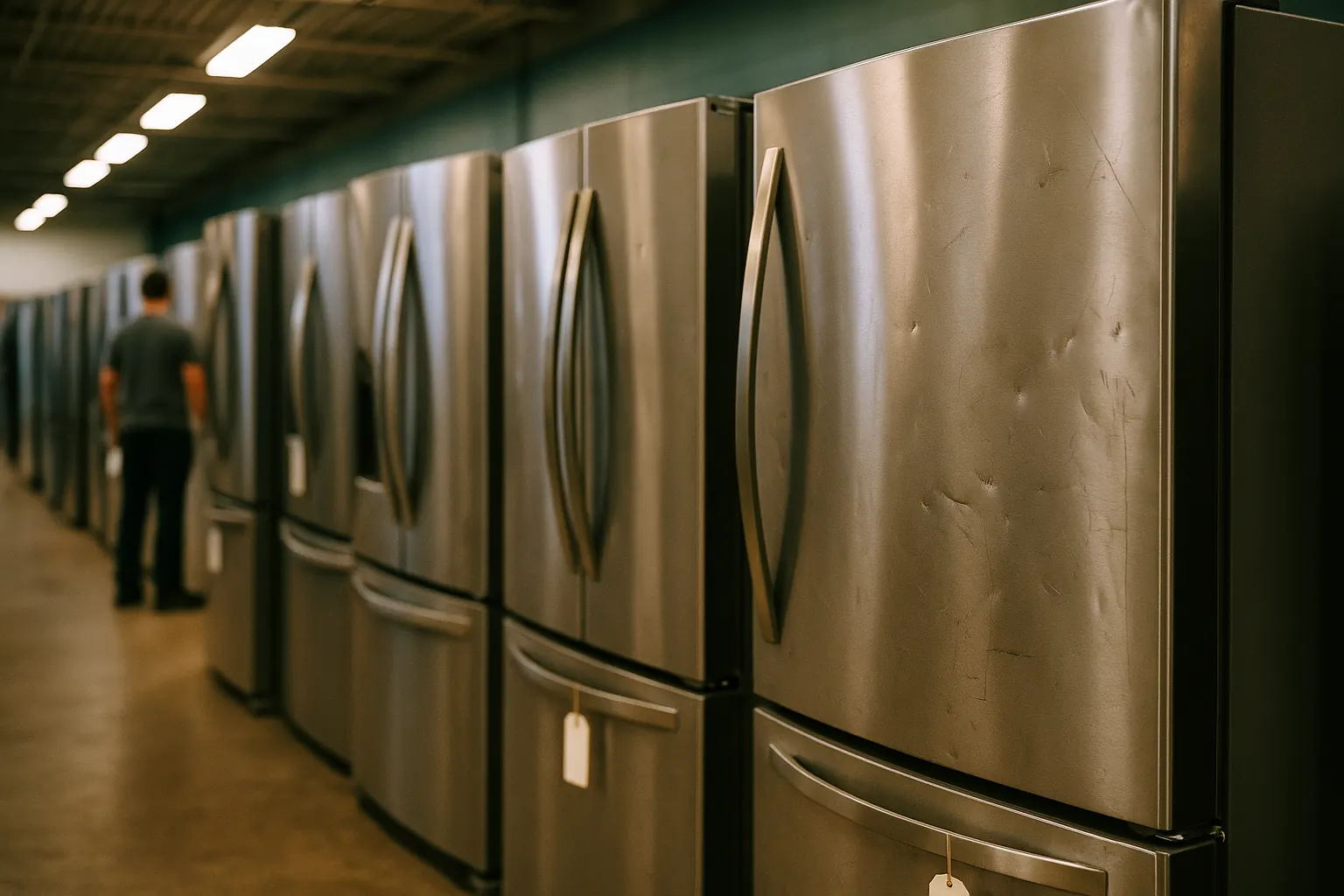
Scratch-and-dent discounts are not set by brand generosity. They are set by four measurable factors: where the damage sits, how visible the category makes it, whether the model year is current, and whether the manufacturer warranty survives. This page gives you the factor table to judge any quoted discount, plus our data on which brands actually show up at independent dealers. We do not publish invented "average discount" percentages; our observed-price index for this category is in development and will publish on this site with its methodology (the Used-Appliance Price Index).
Where the inventory comes from, because it explains the price
A scratch-and-dent unit exists because something went wrong between the factory and a sales floor: a forklift tine, a strap that slipped, a trailer load that shifted. The freight-claim system pays the original retailer for the damage, the unit cannot be sold as new, and it flows out through liquidators and outlets to independent dealers. Two consequences follow. First, the damage has already been priced once, by a claims adjuster, before you ever see the unit, which is why the discount pattern is consistent enough to model with the four factors below. Second, supply is a byproduct of shipping volume, not of demand, so the open-retail brands that ship the most units produce the most dents. The full supply-chain picture, channel by channel, is in where do used appliance stores get their inventory.
The four factors that set the price
| Factor | Deepens the discount | Shrinks the discount |
|---|---|---|
| Damage location | Front panel, door face, visible top | Side/back panel that faces a wall or cabinet |
| Category visibility | Ranges and refrigerators (damage faces the room) | Washers, dryers, dishwashers (sides hidden in install) |
| Model year | Discontinued or superseded model | Current model, full accessory support |
| Warranty status | Coverage voided or unclear | Manufacturer coverage confirmed in writing |
The practical consequence: the strongest value in the category is a unit whose damage lands where its installation hides it. A dented left panel on a washer that sits against a wall is a discount for damage you will never see. That is also why quoted discounts on identical damage differ across categories, and why a single "scratch-and-dent saves X%" number would be meaningless even if someone measured it honestly.
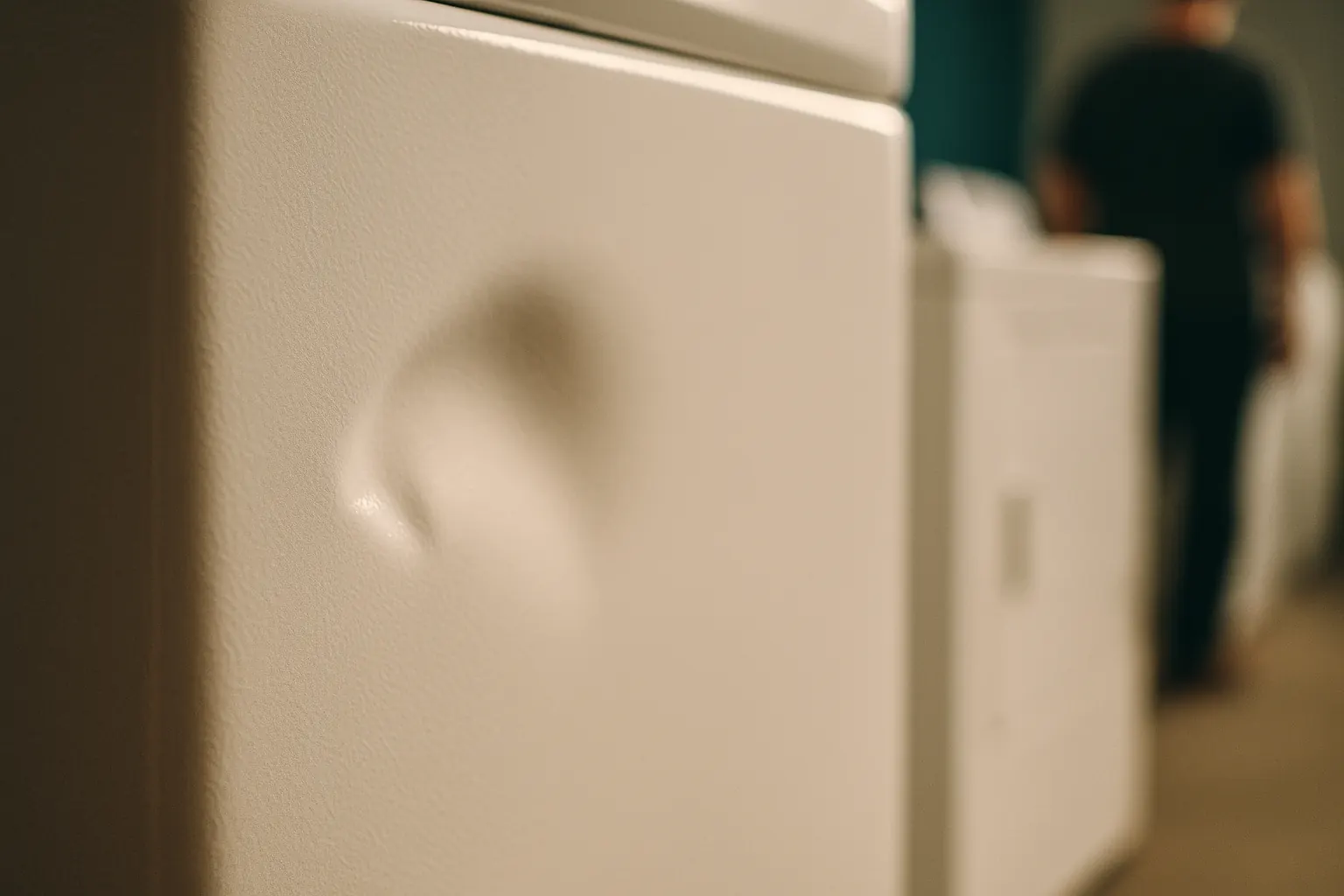
The whole discount, photographed: a shallow side-panel dent that disappears the day the unit slides into its alcove.
Brand availability at independent dealers, from our data
These counts are active stores in our directory associated with each brand. They measure availability at independent dealers, not market share.
| Brand | Stores carrying it | Distribution pattern |
|---|---|---|
| GE | 449 | Open retail; widest independent presence in our data |
| Whirlpool | 413 | Open retail |
| LG | 397 | Open retail |
| Samsung | 342 | Open retail |
| Frigidaire | 292 | Open retail |
| Maytag | 287 | Open retail (Whirlpool family) |
| KitchenAid | 235 | Open retail (Whirlpool family) |
| Bosch | 216 | Open retail, premium tier |
| Speed Queen | 172 | Selective: authorized-dealer network (authorized dealer vs. gray-market appliances) |
| Amana | 165 | Open retail, value tier |
| Wolf | 156 | Selective: showroom/authorized network |
| Electrolux | 141 | Open retail, premium tier |
| Sub-Zero | 137 | Selective: showroom/authorized network |
| Miele | 103 | Selective, premium tier |
Two readings matter. First, the open-retail brands (GE, Whirlpool, LG, Samsung, Frigidaire) dominate independent-dealer shelves, so scratch-and-dent hunting in those brands has the most supply, and supply is what produces the walk-in bargain. Second, the selective-distribution brands (Speed Queen, Sub-Zero, Wolf, Miele) still appear at 100-plus independent dealers each in our data; for those brands, confirming the dealer's authorized status matters more than the discount, because warranty coverage can depend on it.
Category demand and what to check, per category
Search demand tells you where the competition for good units is (volumes: DataForSEO, Google Ads data, 2026-07-10):
| Category | US searches/mo ("scratch and dent" + category) | What to check before buying |
|---|---|---|
| Refrigerators | 3,600 | Door seal integrity, compressor area undamaged, doors close flush |
| Washer + dryer | 1,900 | Drum spins true, no frame distortion, connections intact |
| Dishwashers | 880 | Door alignment and gasket, rack hardware present |
| Ranges | (clusters under the 27,100/mo "scratch and dent appliances near me" head term) | Door glass and hinge alignment, burner/element function |
Refrigerators draw the most category-specific demand, and they are also the category where damage is most likely to matter functionally: a dent near the door gasket or over the sealed system is not a cosmetic problem. Ranges sit at the other pole: highly visible damage, mechanically simple, so the deepest cosmetic discounts with the least mechanical risk. The per-machine 60-second checks behind the table's third column are in how to inspect a used appliance before buying.
The damage that is never worth the discount
Four findings end the negotiation regardless of price, because they convert cosmetic damage into mechanical damage:
- A door that does not close flush. On a refrigerator this is a seal and an energy bill forever; on any appliance it means the frame took the hit, not the panel.
- A dent at a hinge, latch, or gasket line. These parts do work; a dent here is a pre-ordered repair.
- A unit that does not sit level on a flat floor. Racking. The cabinet is a parallelogram now, and a washer built as a parallelogram walks across the room on spin.
- Damage over the sealed system on a refrigerator (the compressor area and the embedded lines). The one repair that totals the machine lives exactly there; see the repair economics in appliance lifespan and repair vs. replace.
Everything else is paint and pride, and paint and pride are what the discount pays you to accept.
The outlet visit, played well
The factor table decides the price; the visit decides whether you get the unit. Outlet inventory is single-lot, so the good unit you photograph on Tuesday is sold by Thursday, and the visit playbook reflects that:
- Go when trucks arrive, and ask when that is. Most outlets receive on fixed weekdays. The floor two hours after a truck is a different store from the floor the day before one.
- Bring the measurements and the photos. Your alcove's width, the doorway, the outlet type on the wall (photographed), and the model number of the machine that died. Every question a dent raises gets answered against these in seconds.
- Run your hands, not just your eyes. Raking light and a flat palm find the dents the aisle lighting hides, and the frame-edge check (does a straightedge or a hand feel a crease at the corners?) is the one that matters, per the never-worth-it list above.
- Ask the two channel questions. "Freight damage or a return?" and "does the manufacturer warranty survive, in writing?" The first sorts new mechanics from used ones (where do used appliance stores get their inventory explains why that distinction is the whole price); the second is the factor table's fourth row settled on paper.
- Decide at the unit. The factor arithmetic in the worked example below runs in two minutes on a phone calculator. A fairly priced unit at an outlet does not wait for a second opinion, and an overpriced one is negotiable now or gone later, either of which resolves today.
The haul-away and delivery lines apply here as anywhere: outlets often charge for both, so the landed-cost math from cheapest way to replace a washer or dryer belongs in the phone calculator too.
Does the warranty survive? The channel decides
The fourth factor deserves its own table, because "does the manufacturer warranty survive the dent" has a structured answer: it depends on how the unit left the original channel, and the seller knows which path theirs took.
| How the unit reached the floor | Manufacturer warranty, typically | What to get in writing |
|---|---|---|
| Dented in the manufacturer/distributor freight network, sold via authorized channel | Survives in full | Registration confirmation with your purchase date |
| Retailer's own freight damage, sold from its outlet arm | Usually survives | The retailer's warranty statement for outlet stock |
| Sold through a liquidator "as-is" | Usually void or unregistrable | The store's own guarantee, or the discount prices the absence |
| Return with damage (ran in a home first) | Clock may date from first sale; unit is used, not S&D | First-sale date; then reprice as used |
"Typically" is doing honest work in that column: practices vary by brand and contract, which is exactly why the writing matters more than the pattern. A seller who cannot say which row their unit sits in has answered the fourth factor: price it as if coverage is absent, because functionally it is.
How do you judge a quoted discount?
- Price the identical model new (model numbers are printed on the unit's rating plate; check two retailers).
- Apply the factor table above: hidden damage on a current model with confirmed warranty should carry a smaller discount than visible damage on a superseded model without coverage. If the price does not reflect the factors, negotiate on the factors, by name.
- Get the warranty answer in writing. This single step separates a real scratch-and-dent bargain from a used-appliance risk profile at a scratch-and-dent price.
- Vet the store itself with the checklist in how to verify a used-appliance store.
A worked example, arithmetic exposed. A current-model $900 french-door refrigerator with a shallow dent on the hinge-side door face, manufacturer warranty confirmed in writing: the damage is visible (deepens) but the model is current with coverage intact (shrinks twice), so a quote around $650 to $700, roughly 25% off, is defensible, and haggling it further means finding another factor. The same unit with an unclear warranty and a superseded model year has two deepeners stacked on the visibility factor, and $500 to $550 is the honest neighborhood. Same dent, $150 of difference, all of it in the paperwork.
Supply-side note from our dataset: 370 of 6,671 active stores show positive evidence of scratch-and-dent inventory, against 1,987 for used, so the category runs at roughly a fifth of the used channel's store count (checked 2026-07-15). Scarcity means the strong units move within days of hitting the floor; if the factor math says a unit is fairly priced, the discount for waiting is usually the unit being gone.
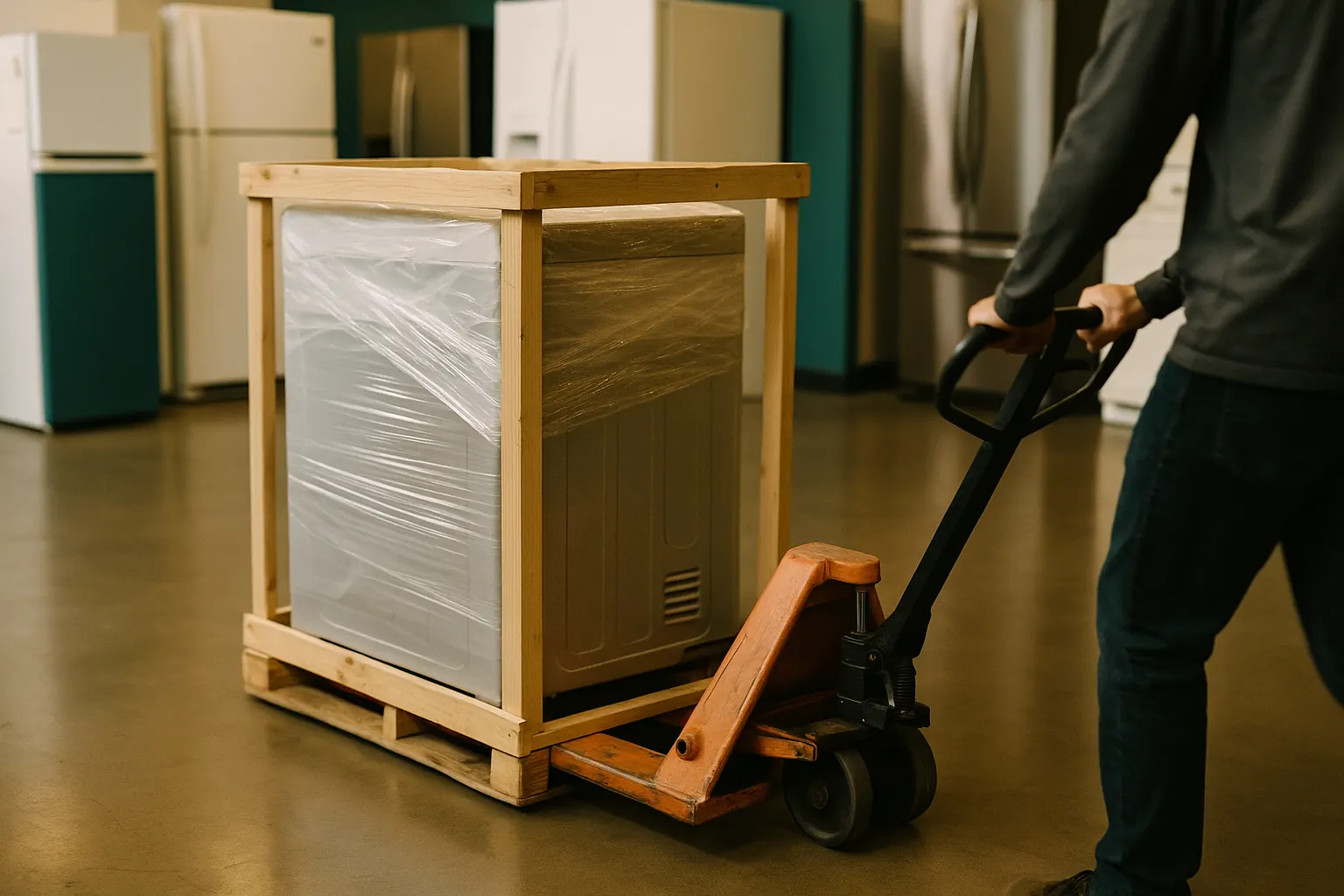
Outlet inventory is a river, not a lake. The factor table is how you decide in one visit instead of three.
Find scratch-and-dent dealers near you on the scratch and dent page, or browse outlets on appliance outlets. For whether the category beats buying used at all, the head-to-head math is in is buying used or scratch-and-dent worth it.
Sources
- usedappliancestores.com store dataset, 2026-07-15 build: 6,671 active listings; brand-association and segment-evidence counts.
- DataForSEO (Google Ads search volume data), pulled 2026-07-10 and 2026-07-14.
- Worked-example discount bands: computed from the factor table against posted new prices, stated as reasoning, not as observed-price data.