Last updated: 2026-08-03 · Written by the usedappliancestores.com data team. Store counts come from our own national dataset of 6,671 active store listings, checked 2026-07-15.
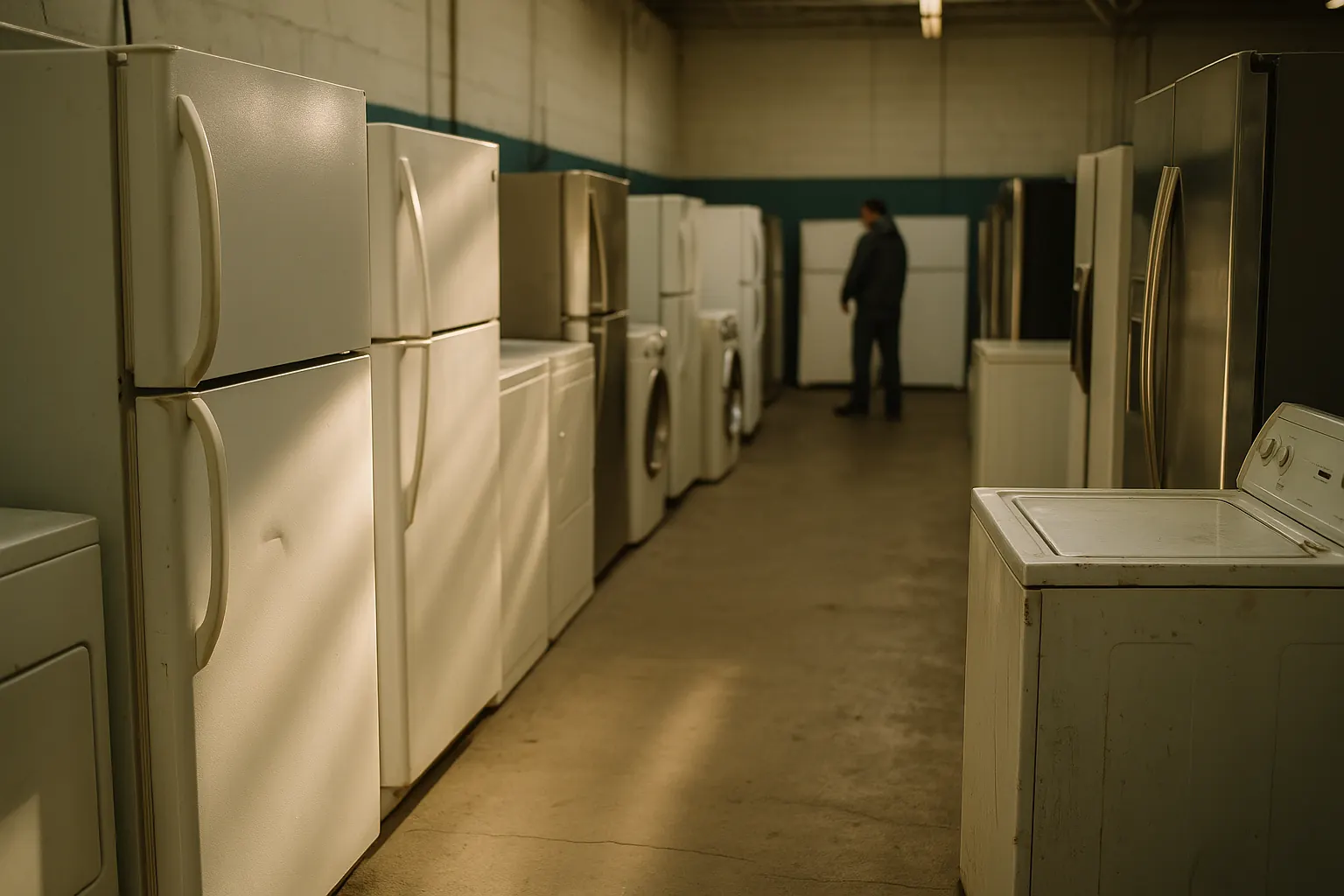
The four terms describe four different things. A used appliance has lived in someone's home. A scratch-and-dent appliance is new but cosmetically damaged, usually in shipping. A refurbished appliance was repaired and tested after a defect or return. An open-box appliance was purchased, unboxed, and returned, often without ever running a cycle. Price, risk, and warranty coverage differ across all four, and stores that sell one do not always sell the others. Sellers also stretch these labels, so the definitions carry more weight than they look like they should.
The comparison table
| Used | Scratch-and-dent | Refurbished | Open-box | |
|---|---|---|---|---|
| Has it been owned and operated? | Yes, in a prior home | No | Sometimes (defect returns) | Briefly or not at all |
| Condition of the mechanics | Worn in proportion to age | New | Repaired and tested | New |
| Condition of the exterior | Varies with prior use | Visibly scratched or dented | Varies | Near-new |
| Typical price against new | 30% to 60% of a comparable new unit | 60% to 80% of the same model new | 50% to 75%, depending on who did the work | 70% to 85% of the same model new |
| Typical seller | Independent used-appliance store | Outlet, freight liquidator, or independent dealer | Manufacturer program or repair-capable dealer | Big-box returns channel or outlet |
| Manufacturer warranty | Almost never remains | Often intact or partially intact; confirm in writing | Seller or program warranty, not the original | Sometimes intact; confirm the purchase date rule |
| Main risk | Unknown remaining lifespan | Damage that is more than cosmetic | Quality of the repair | Missing parts or accessories |
| Main advantage | Lowest entry price | New mechanics below new price | Tested and repaired by a technician | Near-new at a discount |
The price bands are working ranges from the categories' structure, not from a price survey: a used unit's price tracks its remaining life, a scratch-and-dent discount tracks the visibility of the damage, and open-box sits closest to new because nothing about it is worn. Our guide to used-appliance prices by type and region carries the pricing logic in detail; treat the bands here as orientation, not as quotes.
What "used" means
A used appliance was installed and operated in a prior household. Its remaining value depends on age against the appliance's expected lifespan: the National Association of Home Builders' Study of Life Expectancy of Home Components (2007) puts a washer at about 10 years, a refrigerator and dryer at about 13, and a dishwasher at about 9. A five-year-old washer has roughly half its expected life left. A ten-year-old one may have little. The arithmetic is the whole game: a $300 used washer with five years left costs $60 a year, and a $250 one with two years left costs $125 a year. The second machine is cheaper on the tag and twice the price in practice.
So before you look at a price, ask the seller for the model number and the manufacture date. The date is stamped on a plate or sticker, usually inside the door frame or on the back panel, and a seller who cannot or will not read it to you is telling you something. Our guide to appliance lifespan and repair vs. replace carries the full lifespan table by appliance type, and how to inspect a used appliance before buying covers the checks worth running before you pay.
Among the 6,671 active listings in our directory, 1,987 stores show positive evidence of selling used appliances, the largest of the four segments we track. Browse them by state on the used appliances page.
What "scratch-and-dent" means
Scratch-and-dent units are new appliances with cosmetic damage, most often from freight handling. The mechanics have never run. The discount exists because retailers cannot sell a dented unit as new, so the inventory flows to outlets and independent dealers, and the freight-claim system prices the damage long before you see the unit.
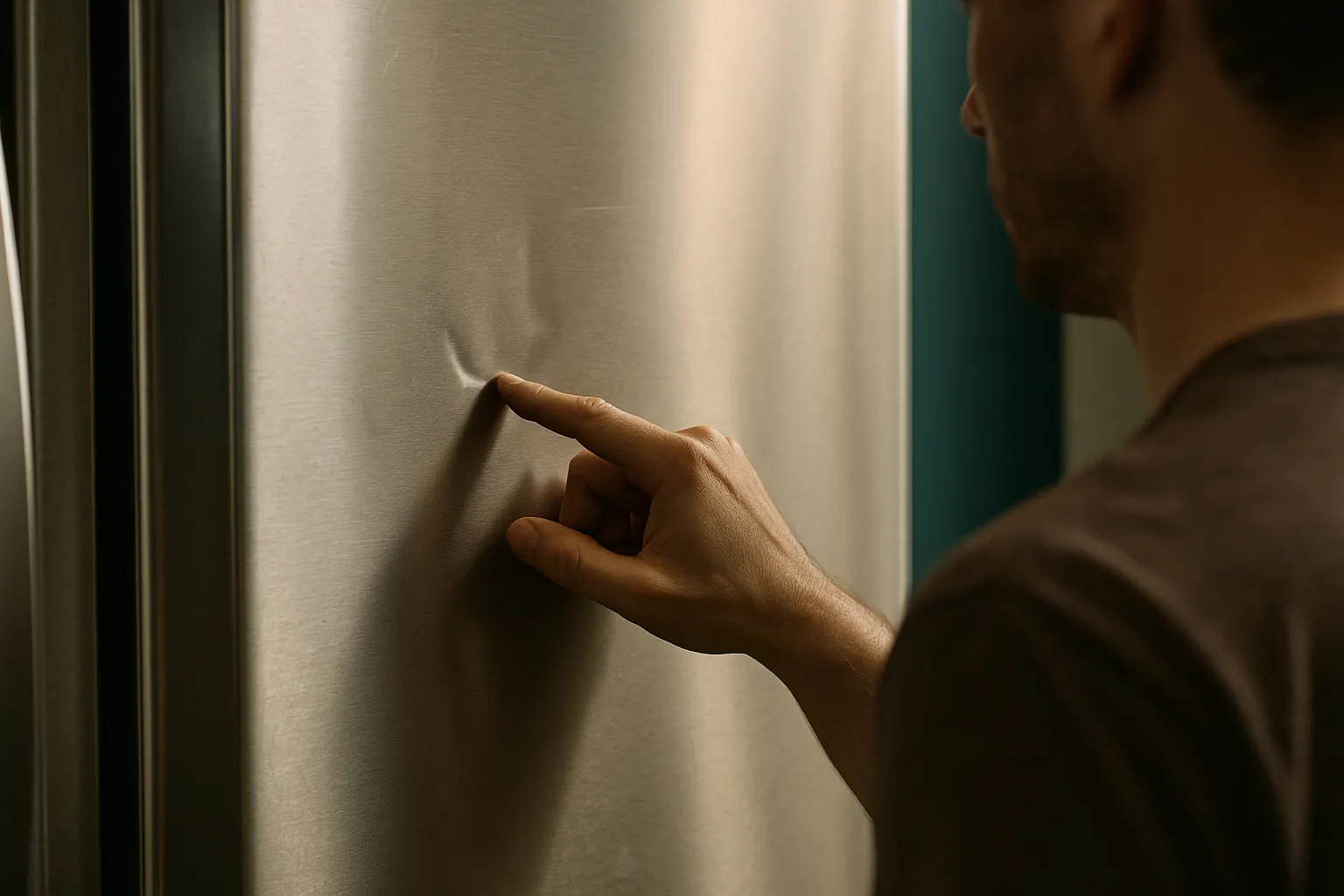
A door-panel dent this shallow is cosmetic. The same dent on a corner of the frame, a hinge, or a seal is a different purchase.
The two questions that matter: where is the damage, and does the manufacturer warranty survive? A dent on a side panel that faces a cabinet costs you nothing. A damaged door seal, a bent frame, or a crushed corner is not cosmetic, because those parts do mechanical work. Run a hand along every edge, open and close every door, and check that the unit sits level. Then get the warranty status in writing. Coverage practices vary by brand and by how the unit left the original channel: a unit dented in the manufacturer's own freight network usually keeps full coverage, while a unit sold "as-is" by a liquidator may carry none.
In our dataset, 370 stores show positive evidence of selling scratch-and-dent inventory. The search demand is real: "scratch and dent appliances near me" draws about 27,100 US searches a month (DataForSEO, Google Ads data, 2026-07-10), and the supply behind it is thin enough that dealers holding it tend to say so plainly. Browse them on the scratch and dent page, and see scratch-and-dent savings by brand and category for what the discount should be by damage type.
What "refurbished" means
A refurbished appliance failed, was returned, or came off lease, and was then repaired and tested before resale. The value of the label depends entirely on who did the work. A manufacturer program or a dealer with an in-house technician can document what was replaced and back it with a written guarantee. A seller who wiped the unit down and relabeled it "refurbished" cannot, and both units wear the same word on the tag.
Ask three things: what was repaired, who repaired it, and what written coverage comes with it. A real refurbisher answers all three without hesitating, because the repair record is the product. If the answer to "what was repaired" is "it was fully tested," you are looking at a cleaned used appliance with a better label. 184 stores in our dataset state that they sell refurbished units, and the ones that do it properly tend to publish their process, because it is their argument for the price.
What "open-box" means
Open-box units were sold, unboxed, and returned, usually for reasons unrelated to function: wrong size, wrong color, a canceled renovation. Most have never run a full cycle.
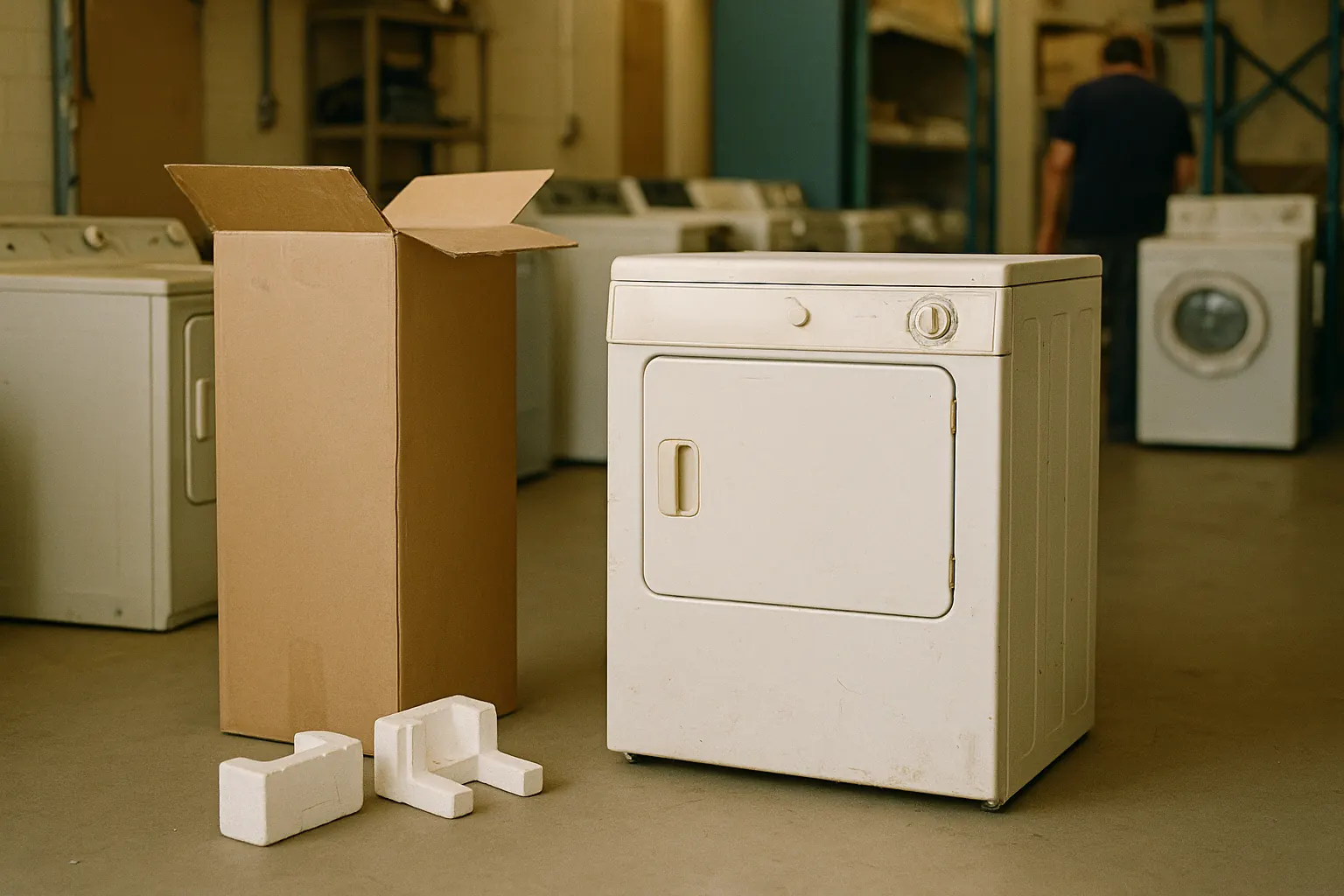
The unit is new. The question is what came back in the box with it.
The risks are specific and checkable. First, missing accessories: racks, hoses, brackets, feet, and manuals leave the box at the first sale and do not always come back. Ask for the contents list of the model and check the box against it, because a missing dryer vent kit or dishwasher rack is a real cost you will pay at the hardware store. Second, the warranty clock: some manufacturers start coverage at the first retail sale, not yours, so a unit returned after three months may carry nine months of a twelve-month warranty. Ask the seller to confirm the warranty start date in writing. 213 stores in our dataset state that they carry open-box inventory, and the category also flows through big-box returns channels and outlets (appliance outlets).
The fifth label: floor models
One more category shows up on sales floors and fits none of the four boxes cleanly. A floor model (or display model) spent months plugged in on a showroom floor. It was never installed in a home, which makes it sound like open-box, but it is not new either: a display refrigerator may have run its compressor for a year under showroom lights, fingerprinted by every shopper who walked past. Dryers and washers on display usually never ran at all; refrigerators and freezers usually ran continuously.
Price a floor model by what it actually did on that floor. A never-run washer floor model is functionally a scratch-and-dent unit without the dent and should be discounted like one, around 20% to 30% off. A refrigerator that ran for a year of display duty has spent a year of compressor life and deserves a used-adjacent discount, not a cosmetic one. Two things to confirm in writing before buying any floor model: whether the manufacturer warranty runs from your purchase date or from the date the store put it on display, and whether the accessories that shipped with it are still in the building. Display units lose their racks, filters, and manuals to the sales floor at a rate somewhere between open-box and yard sale.
The same label means different things on different machines
The four labels behave differently depending on what the machine is, because the failure points differ. A dent matters more on a refrigerator than a dryer. Age matters more on a washer than a range.
| Washer | Dryer | Refrigerator | Range | |
|---|---|---|---|---|
| Used: the age question | Hardest-worn category; bearings and suspension wear with every load | Simpler machine; a 10-year-old dryer can be a fine buy | Compressor hours matter; door seals age visibly | Longest-lived; burners and elements are replaceable |
| Scratch-and-dent: where damage matters | Frame and drum alignment; a bent frame vibrates forever | Mostly cosmetic anywhere; check the door seal | Door seals and hinge-side dents are disqualifying | Cosmetic almost everywhere except the cooktop |
| Refurbished: what should have been replaced | Bearings, suspension, pump, door boot | Belt, rollers, heating element | Compressor start relay, fans, gaskets | Igniters or elements, control board |
| Open-box: what goes missing | Fill hoses, transit bolts | Vent kit, power cord (electric units ship without one) | Shelves, crisper drawers, water filter | Racks, griddle plates, LP conversion kit |
The pattern behind the table: the more moving parts and water a machine handles, the more its history matters, which is why a used washer needs the most scrutiny and a used range the least. The full per-machine inspection routine, with the 60-second test for each, is in how to inspect a used appliance before buying.
Which one should you buy?
| Your situation | The fit | Why |
|---|---|---|
| Lowest possible price, short-term need (rental, temporary housing) | Used | Entry prices are lowest; a short horizon limits lifespan risk |
| New appliance performance on a tight budget | Scratch-and-dent | New mechanics; you pay less for a scratch you may never see |
| You want the unit inspected and repaired by a technician first | Refurbished (documented) | The repair record and test are the product |
| You want near-new condition and the accessories matter | Open-box | Minimal wear, but verify the box contents |
| You need a warranty above all | Scratch-and-dent or open-box with confirmed coverage | These are the two categories where manufacturer coverage can survive |
| The appliance died and the budget is the constraint | Used, from a store that will deliver | Speed and price beat category purity; see the guide below |
If the machine you are replacing is already dead and the question is how to get any working unit installed this week for the least money, that is a different problem than choosing a category, and cheapest way to replace a washer or dryer walks that path end to end. If you are weighing these categories against rent-to-own or store financing, rent-to-own vs. buying used vs. financing compares the total costs.
How sellers stretch these labels
The four categories have no legal definitions in most states, so the label on the tag is a claim, not a certification. Three stretches account for most of the mislabeling we see:
- "Refurbished" that means cleaned. The unit is used, wiped down, and relabeled. The tell is the missing repair record. If nothing specific was replaced, the correct label is "used, tested," and the correct price is a used price.
- "Scratch-and-dent" that has run cycles. A returned unit with a dent is a used appliance with a dent, not a scratch-and-dent unit, because the mechanics have history. Ask whether the unit has ever been installed.
- "As-is" stacked on any label. "As-is" is a warranty disclaimer, not a category, and in most states it strips the implied warranty of merchantability that would otherwise apply to the sale. Whatever the category label says, "as-is" on the receipt controls. Our guide to used-appliance warranty rights by state covers what survives an "as-is" sale in each state.
The defense against all three is the store, not the tag. A store that publishes its refurbishing process, states warranty terms in writing, and answers the manufacture-date question without friction has little room to stretch a label. This is checkable before you visit: of the 6,671 stores in our dataset, only 3,199, which is 48.0%, have a live website at all (checked 2026-07-15), and a store with no web presence can only be vetted in person or by phone. Our how to verify a used-appliance store is the checklist we apply to every listing in the directory, and each store page shows the result.
Whatever the category, vet the store before the appliance. The label tells you what the machine claims to be. The store determines whether the claim means anything.
Sources
- usedappliancestores.com store dataset, 2026-07-15 build: 6,671 active listings; segment-evidence counts (a store's own site text, name, or business category); website-liveness counts from our automated checks.
- National Association of Home Builders / Bank of America, Study of Life Expectancy of Home Components, 2007.
- DataForSEO (Google Ads search volume data), pulled 2026-07-10 and 2026-07-14.
- Uniform Commercial Code §2-314 (implied warranty of merchantability) and §2-316 (exclusion or modification of warranties), as adopted per state.