Last updated: 2026-08-03 · Written by the usedappliancestores.com data team. Store counts come from our national dataset of 6,671 active store listings, checked 2026-07-15.
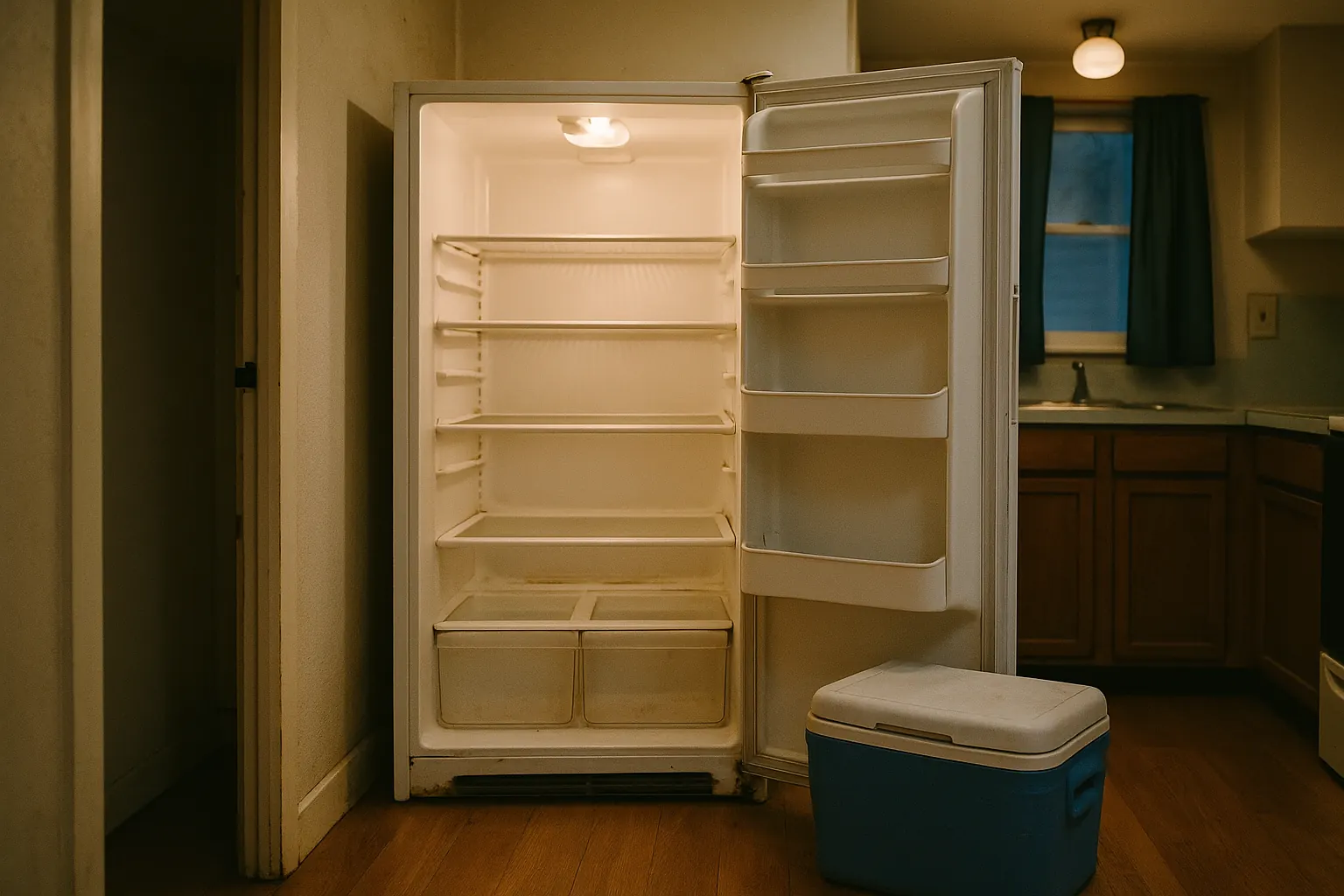
First, the clock: food in a closed refrigerator stays safe for about 4 hours after the unit dies, a full freezer for about 48 hours, a half-full freezer for about 24, per USDA food-safety guidance. Keep the doors shut, move what matters to a cooler with ice, and you have bought yourself one to two days to solve this without losing the groceries too. Second, the checks below revive a surprising share of "dead" refrigerators for free. Third, if it is really gone, the ladder runs from about $60 to a few hundred dollars, and every rung is faster than payday. In order:
Hour one: the clock and the cooler
- Stop opening the doors. Every open costs cold. The 4-hour and 48-hour figures assume closed doors.
- Triage the food into a cooler with ice. Meat, dairy, and anything medical (insulin) first. A bag of ice is $3 to $5; two bags in a decent cooler holds a family's perishables for a day. Frozen goods pack together in the freezer and insulate each other; leave them there until hour 24.
- The 40°F rule decides later. Perishables above 40°F for more than 2 hours get discarded, per USDA. When in doubt, throw it out; food poisoning is the one outcome more expensive than the refrigerator.
Hour two: the five checks that revive dead fridges for free
A refrigerator that went dark is not always a refrigerator that died. Run these in order, ten minutes total:
- The outlet, not the fridge. Plug a phone charger into the same outlet. Dead outlet: check the breaker panel for a tripped breaker or GFCI. This resolves more "dead" refrigerators than any repair.
- The cord and the plug. Fully seated, no visible damage, no extension cord doing secret duty behind the unit.
- The controls. A knob bumped to "off" during cleaning, a control board showing a demo or vacation mode. Check the dial or panel before anything else mechanical.
- Light on but warm: listen from the back. A repeating click every few minutes is usually the start relay, a $20 to $40 part that a handy person can swap and any tech can fit cheaply. A steady hum with no cooling plus hot coils points at the condenser fan or dirty coils: unplug, vacuum the coils (back or beneath, behind the kick plate), give it two hours.
- Iced-over back wall inside the freezer: the defrost system. Unplug it, doors open, towels down, 24 hours fully defrosted, then restart. If it cools again, you have bought weeks to months, enough to shop instead of scramble.
If the compressor hums and dies, or the unit runs constantly without cooling after the coil cleaning and defrost, it is likely a sealed-system failure, and the repair economics in appliance lifespan and repair vs. replace say that on a unit past 8 or 9 years, that quote ($600 to $1,200 typical) fails the replacement math for almost everyone. At that point you are shopping, and the ladder starts.
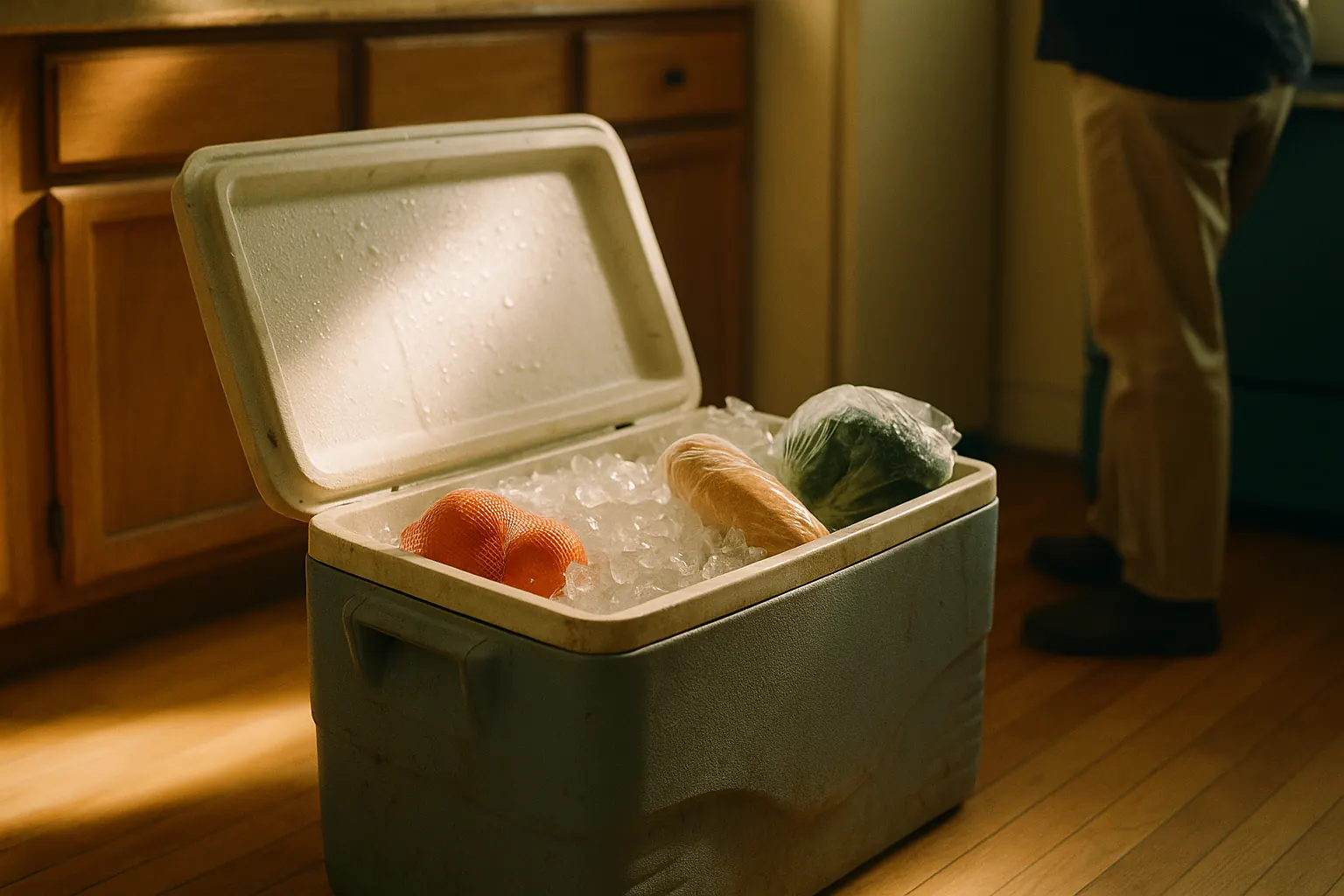
The bridge: $5 of ice a day holds the essentials while you work the ladder below.
Hour 24 and 48: what stays and what goes
When power or cooling comes back, or when the cooler becomes the fridge for a second day, the USDA's keep-or-toss rules earn their own table, because instinct gets this wrong in both directions:
| Food | Above 40°F over 2 hours | Notes |
|---|---|---|
| Raw or cooked meat, poultry, seafood | Discard | The non-negotiable row |
| Milk, soft cheese, opened cream | Discard | Smell is not a safety test |
| Eggs | Discard | |
| Hard cheeses, butter, margarine | Keep | Hard cheese tolerates the outage |
| Fruit juices, whole fresh fruit | Keep | |
| Condiments: ketchup, mustard, pickles, jam | Keep | Vinegar and sugar are the preservatives |
| Bread, peanut butter, dry goods | Keep | Never needed the fridge |
| Refrozen items with ice crystals still present | Safe to refreeze | Quality drops, safety holds, per USDA |
Two rules carry the table. "When in doubt, throw it out" applies to every protein row, because the failure mode is a medical bill. And the freezer is the ally: a full, closed freezer holds 48 hours, its contents refreeze safely while ice crystals remain, and packing the fridge's must-keep items into the freezer's cold mass on hour one is the move that saves the most food per minute of door-open time.
The ladder: cheapest to fastest, all of it this week
Every rung gets a working refrigerator into the kitchen. Costs are typical; your county will vary.
| Rung | What | Typical all-in cost | Timeline | The catch |
|---|---|---|---|---|
| 1 | Free: curb alerts, buy-nothing groups, a neighbor's garage fridge | $0 + hauling | 1-3 days of watching | No history, no testing; inspect hard |
| 2 | Estate sales, storage auctions | $30-100 + hauling | This weekend | Dormancy risk: dried seals, gummed valves |
| 3 | Nonprofit resale (ReStore-class) | $75-200, some tested | 1-2 store visits | Selection is luck; usually no delivery |
| 4 | Marketplace listings, tested at the seller's home | $100-250 + hauling | 1-3 days | No recourse at all; test before paying |
| 5 | Independent used dealer, written guarantee | $200-450 delivered | Same day to 2 days | The most money on this list, and the most protection |
| 6 | Compact/dorm fridge new, as a bridge | $60-150 | Today, retail | Not a solution; a bridge that keeps insulin and milk cold |
Three notes that change outcomes on this ladder:
- Rung 6 stacks under everything. A $60 compact fridge today takes the panic out of rungs 1 through 5, and it becomes the garage fridge later. If the cooler is losing the battle and the ladder needs a week, the bridge is the honest move.
- Rungs 1, 2, and 4 are self-haul. A refrigerator moves upright, strapped to a hand truck ($20 rental if no one you know owns one), and rides standing up; a fridge hauled lying down needs hours upright before plug-in. Budget the truck and the second pair of hands into the "cheap" rungs.
- Rung 5 is where the used market's paper lives. A dealer's tested unit with a written 90-day guarantee, delivered, with the corpse hauled away, converts a crisis into an errand. Whether that is worth the premium over rung 4 is exactly the spread between $150 and $300 discussed across best places to buy used appliances; when the budget is truly rigid, it usually is not, and when a second failure would be unaffordable, it usually is.
On our data, the supply for rung 5 exists nearly everywhere: 1,987 of the 6,671 active stores in our directory show positive evidence of used inventory, across all 50 states, and refrigerators are the highest-turnover category on used floors. But call before you drive: only 28.5% of stores publish a checkable phone number and only 48.0% have a live website (checked 2026-07-15), so the directory listing plus one call is how you confirm today's floor has a fridge in your budget. Start at the browse checked stores by state.
Inspecting a refrigerator when you cannot afford to be wrong
The full routine is in how to inspect a used appliance before buying; the refrigerator-critical subset, for a driveway or a store floor:
- Run it, or watch it run. Cold at the vents within minutes on a running unit; a unit that has "been in the garage, works great" but is warm and unplugged is an act of faith, not a purchase.
- The door gasket. Close the door on a dollar bill; real drag means real seal. A dried, cracked gasket is a $50 to $100 fix and an energy bill.
- The manufacture date, off the rating plate inside the door. Against the NAHB's ~13-year refrigerator lifespan, a 10-year-old unit is a $50 machine no matter how clean, and a 4-year-old one is the find. The arithmetic is in used-appliance prices by type and region.
- Listen at the back. Smooth hum: fine. Clicking, buzzing, or silence with a lit interior: the exact failures you just escaped.
The first week with the replacement
A used refrigerator's failure risk concentrates in its first week of renewed duty, especially off the dormancy-heavy rungs, so the replacement earns a short probation:
- Let it stand before plugging in if it traveled on its side: the working rule is upright at least as long as it lay down, and a few hours minimum, so the compressor oil settles back where it belongs. Units moved upright can start immediately.
- Give it a quiet first night. A healthy unit pulls down to temperature within four to six hours and then cycles: hum, rest, hum. Continuous running past the first day means dirty coils, a failing seal, or worse; catch it now, while the seller's guarantee or your negotiating memory is fresh.
- Thermometer in a glass of water on the middle shelf. $3 at the hardware store, read it on day two: 35°F to 38°F is right. This is the check that converts "seems cold" into a number, and the number is what a guarantee conversation needs.
- Restock gradually. Big warm grocery loads in the first days mask a weak unit's symptoms and stress a marginal one. The cooler earned one more day of service anyway.
- Day seven, call it. Holding temperature, cycling normally, gaskets gripping: keep the receipt with the guarantee stapled to it and move on with your life. Anything else: back to the seller inside the guarantee window, with your thermometer reading written down.
What if the money is the whole problem?
Two doors beyond the ladder, both free to try: your utility company (some run appliance-replacement or rebate programs for income-qualified households, one phone call to ask) and 211, which routes to local assistance programs that sometimes cover essential-appliance replacement. Neither is fast, so they pair with the bridge fridge, not against the clock. The wider set of no-credit routes, priced honestly, is in buying appliances with bad credit.
Cold milk tonight, at a price that leaves the rest of the month intact.
Sources
- USDA Food Safety and Inspection Service, "Keeping food safe during an emergency": the 4-hour refrigerator, 24/48-hour freezer, 40°F/2-hour rules.
- National Association of Home Builders / Bank of America, Study of Life Expectancy of Home Components, 2007 (refrigerator ~13 years).
- Repair-quote ranges: typical out-of-warranty parts-plus-labor ranges, per the tables in our lifespan guide; stated as ranges, not a survey.
- usedappliancestores.com store dataset, 2026-07-15 build: 6,671 active listings; used-inventory evidence, phone and website coverage.